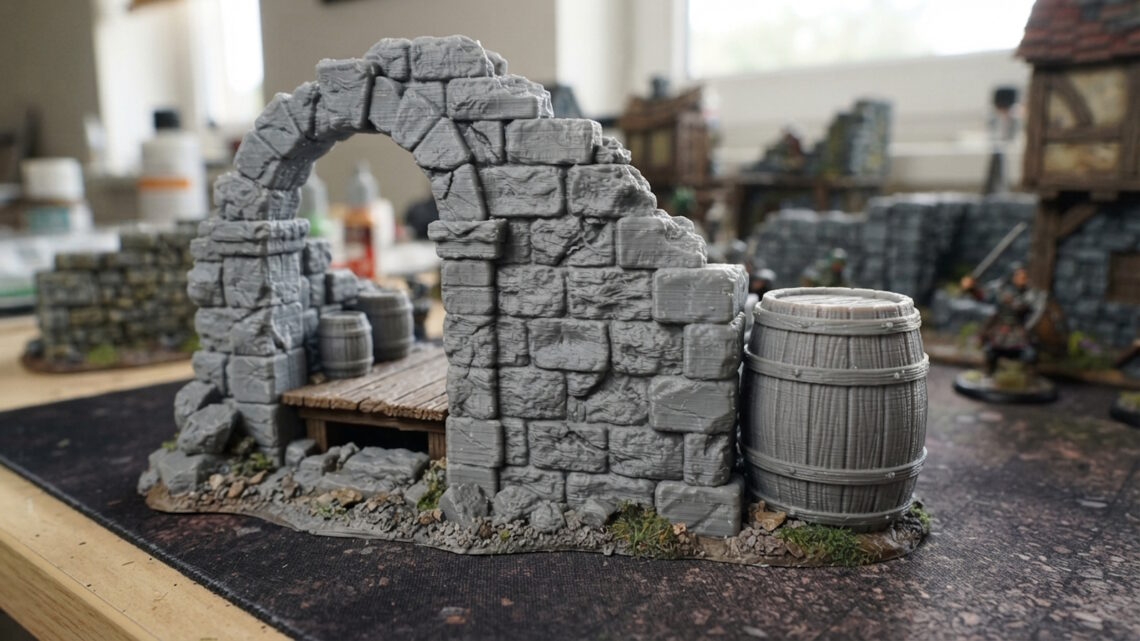
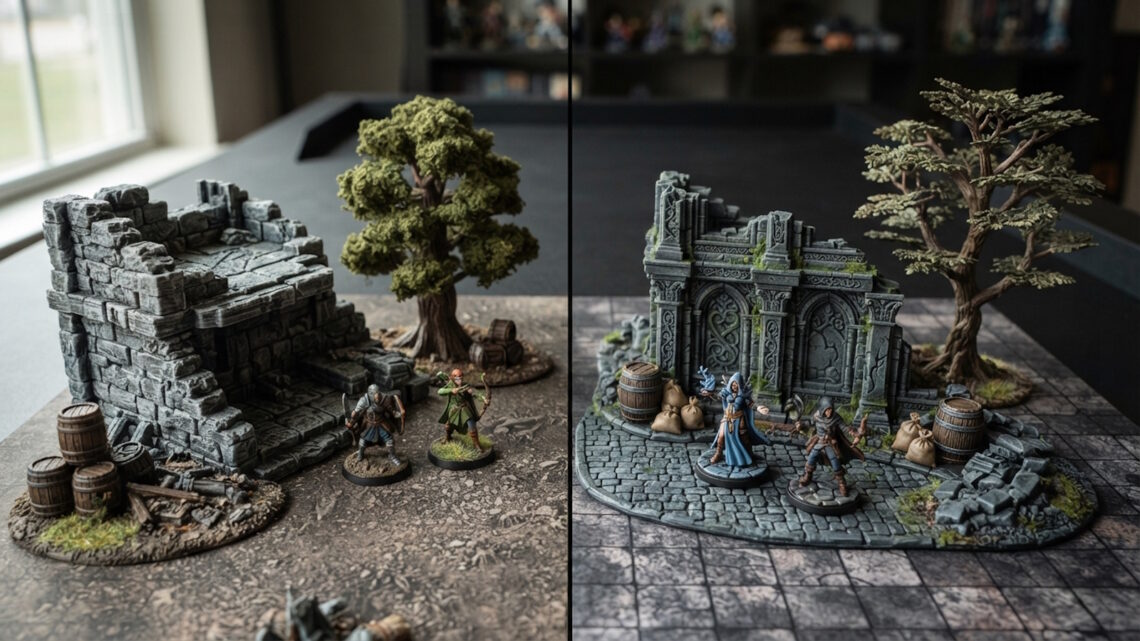
3D printing now serves as a practical method for creating tabletop terrain, especially for gamers seeking customisation, repeatable scenery.
One of the most common technologies used for larger terrain is FDM 3D printing.
FDM stands for fused deposition modelling. Instead of using liquid resin, an FDM printer builds an object layer by layer by melting and depositing filament.
For tabletop terrain, this can be particularly useful for larger pieces such as trees, crates, barrels, ruins, walls and other scenery.
What is FDM 3D printing?
An FDM printer uses a spool of thermoplastic filament.
The filament is fed into a heated nozzle, melted and deposited onto the print bed.
The printer gradually builds the object one layer at a time.
Because the process is relatively straightforward and filament is available in many colours and materials, FDM printing has become popular for hobby projects.
For terrain, the technology has another major advantage: it can produce relatively large objects without the material requirements associated with printing the same object using resin.
Why is FDM useful for terrain?
Terrain is generally much larger than individual miniatures.
A barrel, tree stump or building can contain a significant amount of material.
FDM printing suits these larger objects well because it can produce substantial pieces while using material efficiently.
It also makes it practical to print multiple copies of the same object.
This is useful when building a forest containing several trees or a settlement requiring numerous crates and barrels.
PLA filament
PLA is one of the most commonly used FDM printing materials.
It is popular because it is relatively easy to print and is available in a wide range of colours.
For tabletop terrain, PLA can be suitable for many decorative and gaming pieces.
The material is rigid and can produce detailed textures when the printer is properly configured.
Different PLA formulations can have different finishes and characteristics, so the final appearance can vary between products and manufacturers.
Understanding layer lines
One of the most recognisable characteristics of FDM printing is the possibility of visible layer lines.
Because the object is built one layer at a time, the surface can show the individual layers.
How noticeable they are depends on factors including:
- Layer height
- Model geometry
- Print orientation
- Material
- Printer settings
- Lighting
Layer lines are not automatically a defect.
On terrain such as tree bark, stone, logs and rough wooden objects, surface texture can actually complement the appearance of the model.
Layer height and terrain
A smaller layer height generally allows the printer to reproduce finer vertical detail.
A larger layer height can reduce print time.
For terrain, there is often a useful balance between appearance and production time.
A highly detailed display piece may benefit from finer settings, while a large gaming object may not need the same level of surface refinement.
The best setting depends on the model.
A chunky barrel does not necessarily benefit as much from an extremely fine layer height as a piece containing delicate decorative detail.
Supports
Some 3D printed terrain requires support material.
Supports are temporary structures printed to hold overhanging sections during the print.
Good model design can reduce the amount of support required.
Terrain designers often take print-ability into account when creating models.
This can make the final printing process faster and reduce material waste.
When choosing printed terrain, it is useful to consider whether the model has been designed specifically with FDM printing in mind.
Print orientation matters
The direction in which a model is printed can affect both appearance and strength.
It can also influence the visibility of layer lines.
A terrain piece may have an orientation that produces better results even if another orientation appears shorter or quicker.
This is one of the reasons that a good FDM terrain profile is not simply about choosing the lowest possible layer height.
The complete printing process matters.
Infill
FDM objects do not necessarily need to be completely solid.
A printer can create an internal structure known as infill.
The amount and pattern of infill can influence:
- Weight
- Strength
- Print time
- Material usage
For larger terrain pieces, a moderate amount of infill can provide a useful balance.
The appropriate amount depends on the design.
A decorative object that will mostly sit on a gaming table does not necessarily require the same internal structure as a part that will experience heavy mechanical stress.
Walls and shells
The outer walls of a printed object can be particularly important for terrain.
Increasing the number of walls can improve the robustness of some models.
This can be useful for terrain that will be repeatedly handled, transported and stored.
Again, there is no universal setting.
The right balance depends on the model and intended use.
FDM compared with traditional terrain
Traditional terrain can be made from many materials, including foam, cardboard, wood, plastic and resin.
FDM printing provides another option.
Its biggest advantages are repeatability and flexibility.
If you need five similar crates, you can print five.
If you decide that a forest needs more trees, you can print additional trees.
This makes it possible to gradually expand a terrain collection.
FDM terrain and painting
Once printed and prepared, FDM terrain can be painted using normal hobby techniques.
Priming can provide a consistent surface.
Base coats establish the main colours.
Washes can emphasise recesses.
Dry brushing can highlight raised textures.
These techniques work particularly well on terrain because the pieces are usually larger than individual miniatures.
You can find more detailed advice in a guide to painting 3D printed tabletop terrain.
Is FDM terrain suitable for gaming?
For many types of scenery, yes.
FDM is particularly useful for objects that are primarily decorative or used as physical terrain.
Trees, logs, barrels, crates, rocks and similar pieces can all be produced using FDM printing.
The suitability of a particular model depends on its design and intended use.
Delicate decorative elements may require more care than chunky scatter terrain.
What makes a good FDM terrain model?
A good terrain model should consider more than how it looks on a computer screen.
It should also be practical to print.
Useful characteristics include:
- Reasonable overhangs
- Suitable wall thickness
- Practical proportions
- Good stability
- Useful footprints
- Appropriate detail
- Easy handling
For gaming terrain, usability is just as important as appearance.
Final thoughts
FDM 3D printing is a practical technology for creating tabletop terrain because it combines repeatability, flexibility and relatively straightforward production.
PLA filament can be used for a wide range of terrain, while different print settings allow the balance between detail, strength and printing time to be adjusted.
Visible layer lines are part of the technology, but they are not necessarily a problem, particularly on textured terrain.
For gamers building a flexible collection of trees, barrels, crates, logs, ruins and other scenery, FDM printing can be an effective way to expand a gaming table gradually.