Making a miniature scene look realistic isn’t necessarily about adding as much detail as possible.
Realism usually comes from the relationship between the different elements.
Scale, texture, colour, weathering, composition and small imperfections all contribute to the impression that the miniature represents a real environment.
Get the Scale Right
Scale is one of the first things viewers notice.
Trees, buildings, doors, furniture and props should feel as though they belong to the same world.
A single oversized object can make an otherwise convincing scene look less believable.
Keep your main scenery consistent and consider how objects would relate to a person standing beside them.
Avoid Perfect Repetition
Real environments are irregular.
Trees aren’t identical.
Rocks aren’t evenly spaced.
Buildings aren’t positioned at exactly the same angle.
Try to avoid repeating the same arrangement throughout a scene.
Even identical terrain pieces can look different when rotated, grouped differently or placed in different locations.
Use Colour Variation
Painting every surface with one flat colour can make terrain look artificial.
Stone can contain several related shades.
Wood can vary from dark brown to weathered grey.
Ground can contain patches of different earth tones.
The variations don’t need to be dramatic.
Subtle changes create more visual depth.
Add Weathering
Weathering suggests that objects have existed in the environment.
Wood can have darker recesses and worn edges.
Stone can have darker areas where dirt might accumulate.
Paths can become less distinct around their edges.
The key is restraint.
If every surface is heavily weathered, the scene can look less realistic rather than more.
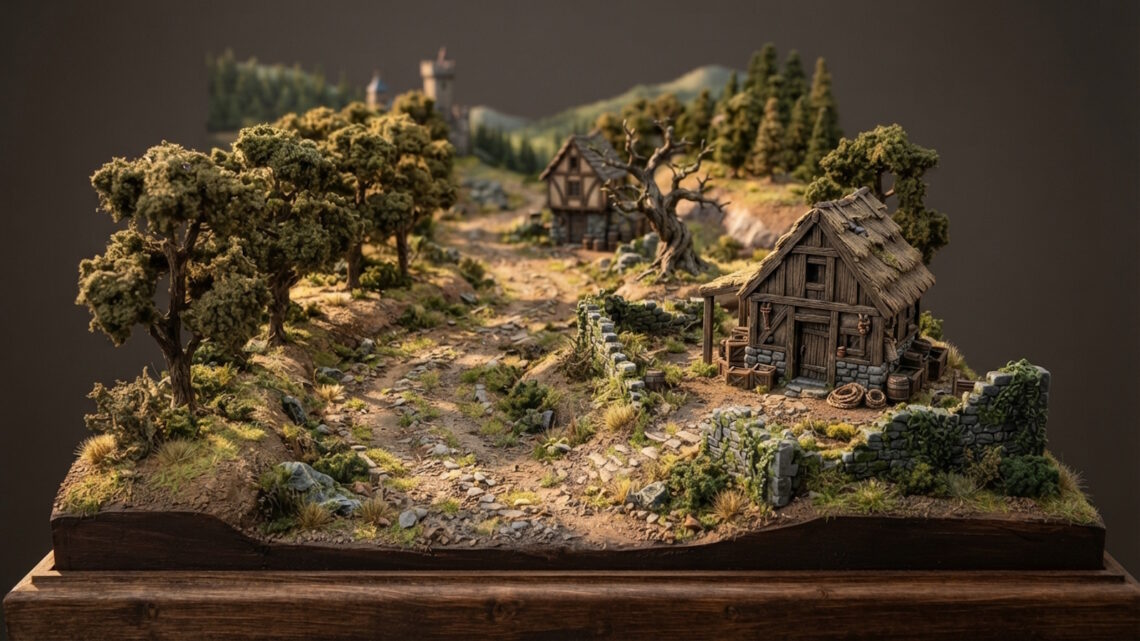
Create Natural Transitions
One of the biggest differences between a model collection and a believable environment is how objects meet the ground.
A tree shouldn’t appear to simply stand on top of the surface.
Vegetation, roots, soil or small stones can help integrate it.
The same applies to buildings and walls.
Adding ground details around the base helps scenery feel embedded in the environment.
Use Different Heights
Flat scenes can look unconvincing.
Introduce height variation.
Tall trees, buildings and walls can be combined with medium-sized rocks, logs and props and smaller ground details.
This creates layers.
It also makes the scene more visually interesting from different viewing angles.
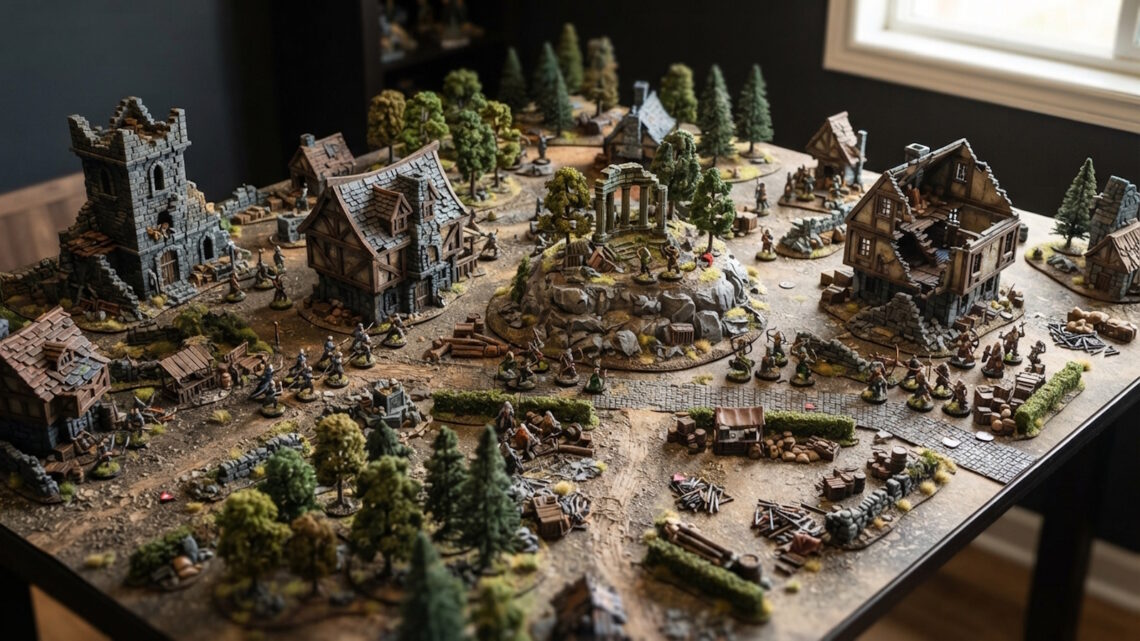
Create Depth
Depth can be created through overlapping objects.
A tree partially covering a building can make the scene feel deeper.
A path disappearing behind scenery can suggest that the environment continues beyond the visible area.
Use foreground, middle ground and background elements rather than putting everything on one visual plane.
Don’t Fill Every Gap
Real environments contain empty spaces.
Leaving some open areas creates contrast.
It also makes detailed areas more noticeable.
If every square centimetre contains scenery, individual objects can lose their importance.
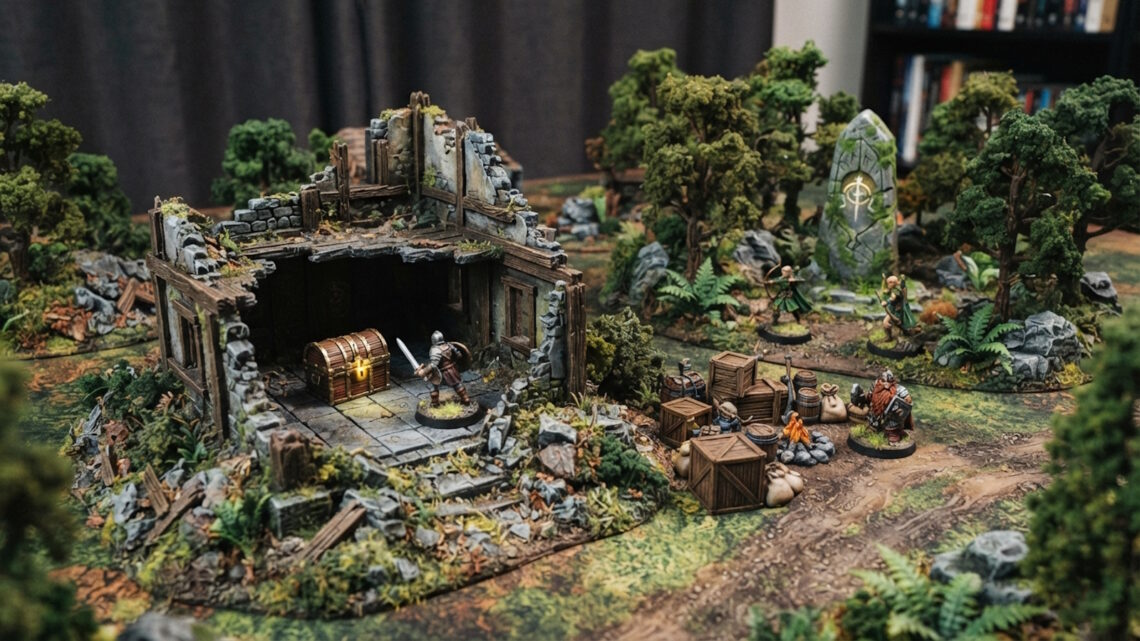
Add Evidence of Life
Small props can make a scene feel occupied.
Barrels, crates, sacks, benches, carts and tools can suggest that people use the environment.
Even if there are no figures present, these objects can imply activity.
For abandoned scenes, the opposite can work.
Broken objects, overgrown paths and neglected structures can suggest that people were once there.
Think About the Story
Ask yourself what happened in the scene.
A path leading towards a building suggests movement.
A pile of crates suggests storage.
A damaged wall suggests an event.
Trees growing around ruins suggest time passing.
These relationships create realism because they give the objects a reason to be there.
Photographing the Finished Scene
Photography can also affect how realistic a miniature looks.
A low camera angle can make the scene feel larger.
A shallow depth of field can reduce the visual clues that reveal its small size.
Lighting is important too.
Strong, natural-looking directional light creates shadows and helps reveal textures.
A realistic miniature scene doesn’t have to contain hundreds of individual details.
It needs believable relationships between its elements.
Get the scale right, vary the terrain, introduce subtle weathering, create depth and use small details to suggest how the environment is used.
Those techniques can turn a collection of miniature pieces into a scene that feels like a genuine little world.