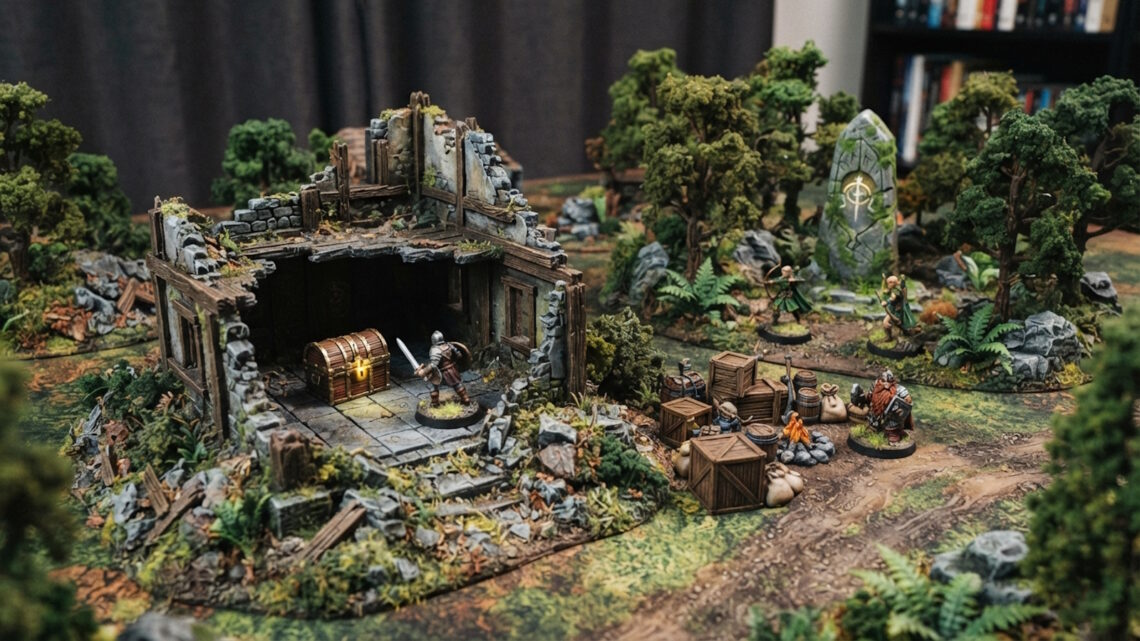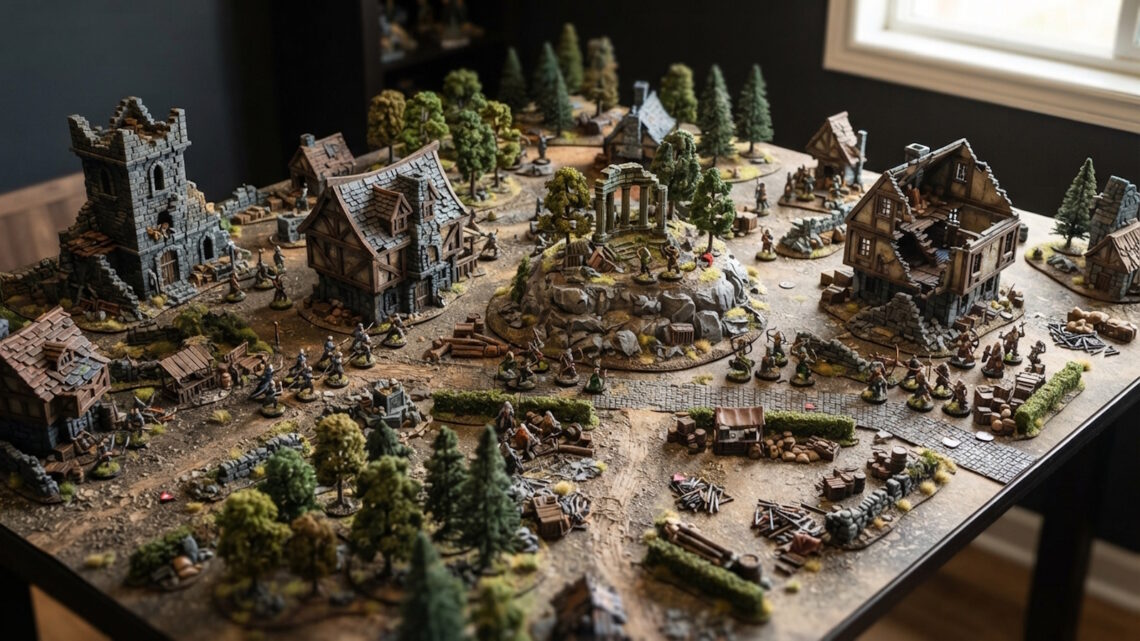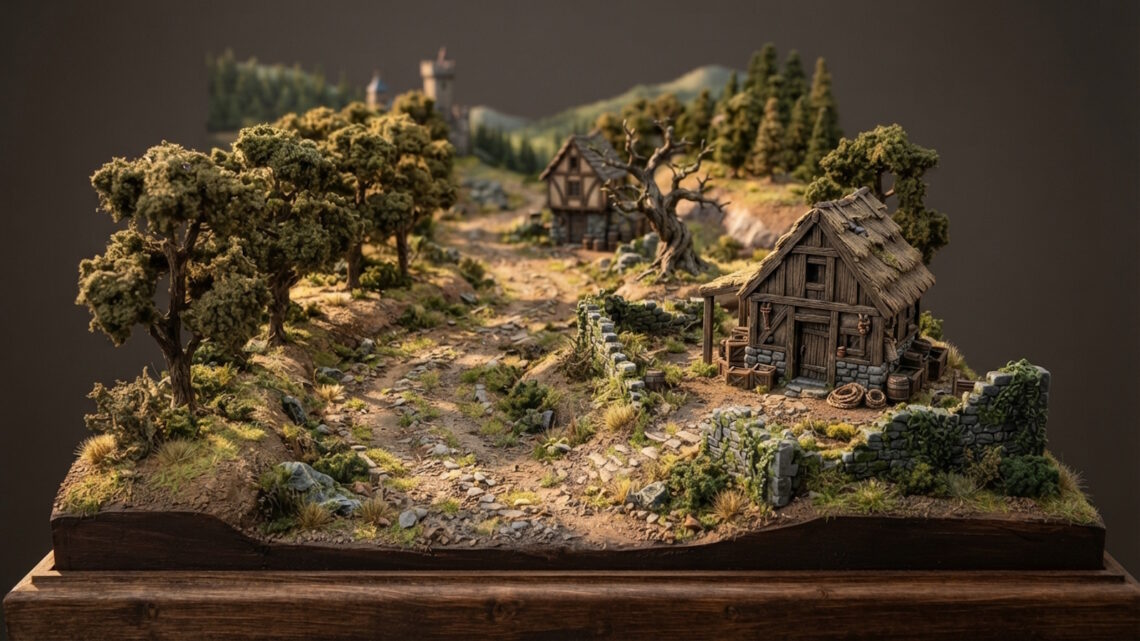
Roads and paths are more than just pieces of ground in a miniature scene. They connect different parts of an environment and give the viewer a route through the world.
A well-designed path can lead towards a building, disappear into woodland or curve around a ruined structure.
For that reason, paths are particularly useful in dioramas and miniature world building.
Decide Where the Path Leads
Before creating the path, decide what it connects.
It might run from a village towards a forest, connect two buildings or disappear into the distance.
Knowing its destination helps determine the shape.
Avoid Perfectly Straight Paths
Natural roads rarely look perfectly straight.
A gentle curve can make a miniature scene more interesting and create a stronger sense of depth.
You don’t need an extreme curve.
Even a slight change in direction can make a significant difference.
Choose the Surface
The surface should suit the environment.
A village might have cobbles or compacted earth.
A woodland path could be mostly dirt with exposed stones and roots.
A well-travelled road might have deeper tracks, while an abandoned route could be partially overgrown.
Vary the Width
Paths don’t need to remain exactly the same width.
A road can widen near a building and narrow as it enters woodland.
This makes it feel less manufactured.
Small variations also help integrate the road with surrounding terrain.
Add Edges
The edges are where a path becomes part of the wider scene.
Add stones, grass, roots, fallen branches or small pieces of debris.
Avoid creating a perfectly clean boundary.
Natural transitions are usually more convincing.
Use Terrain Beside the Path
Place scenery along the route.
Trees can frame a woodland path.
Ruined walls can create a narrow passage.
Barrels or crates can suggest a settlement.
Rocks can create a natural obstacle.
The important thing is not to block the route completely unless that is intentional.
Create Depth
A path is an excellent tool for creating depth because it can lead the eye from the foreground towards the background.
Place larger details closer to the viewer and smaller or less detailed scenery further away.
A winding path can reinforce this effect.
Add Signs of Use
A road can tell the viewer how it is used.
A busy village route might have barrels, crates and carts nearby.
A rural path might have hoof marks, stones and vegetation.
An abandoned road could be partially covered by weeds and debris.
These details make the path feel connected to the fictional world.
Don’t Overdecorate
The path itself should remain visible.
If too much scenery covers it, the visual route disappears.
Leave enough open ground that the viewer can clearly understand where the road goes.
This is particularly important when the road is one of the main compositional elements.
Connect Different Environments
One of the most useful things about paths is that they can transition between environments.
A cobbled village street might gradually become a dirt road before turning into a woodland track.
This allows different terrain styles to exist together naturally.
A good path therefore doesn’t simply sit between scenery. It helps explain why the different areas belong together.
When building miniature scenes, think of roads and paths as part of the storytelling.
Their direction, width, surface and surrounding terrain can tell the viewer where the characters of the scene might travel and what lies beyond the visible area.