Objectives give players a reason to move around a battlefield.
A simple objective marker can work perfectly well, but using terrain itself can make an objective feel much more connected to the gaming table.
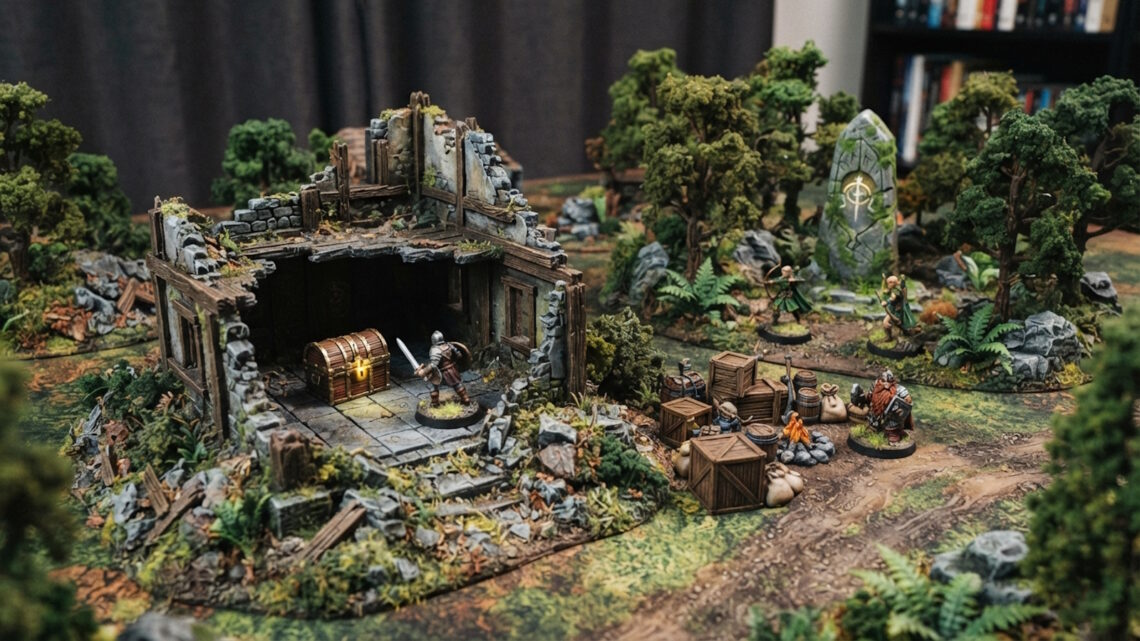
A chest can become a treasure objective.
A ruined building can represent an important location.
A group of crates might contain supplies.
A particular tree, tomb or stone structure could become the focus of a scenario.
Using terrain in this way can make objectives more visually interesting while giving the battlefield additional character.
Why Use Terrain as an Objective?
An objective marker tells players where they need to go.
Terrain can tell them why they need to go there.
A chest immediately suggests treasure.
A pile of crates suggests supplies.
A ruined structure might contain something important.
A prominent stone monument could represent a sacred location.
This visual storytelling makes objectives easier to understand at a glance.
Use Chests for Treasure
Chests are one of the simplest terrain-based objectives.
In a fantasy game, a chest can represent:
- Treasure
- Magical items
- Supplies
- Important documents
- Quest items
You can place one or several chests around the battlefield.
Players then have an obvious reason to move towards them.
A chest also works particularly well inside ruins, dungeons and abandoned buildings.
Use Buildings as Objectives
A building can represent a much larger objective area.
For example, players might need to:
- Capture a tavern
- Search a ruined house
- Defend a temple
- Occupy a tower
- Recover an item from a building
The building itself becomes part of the scenario.
This also means players interact with the terrain rather than simply moving towards a small marker.
Create Supply Objectives
Crates, barrels and sacks can represent supplies.
This works particularly well for village, military camp, tavern and trading scenarios.
A group of crates can represent an important delivery.
Barrels could contain food or water.
Sacks could represent valuable materials.
Grouping several objects together makes the objective more visually obvious.
Use Ruins as Strategic Locations
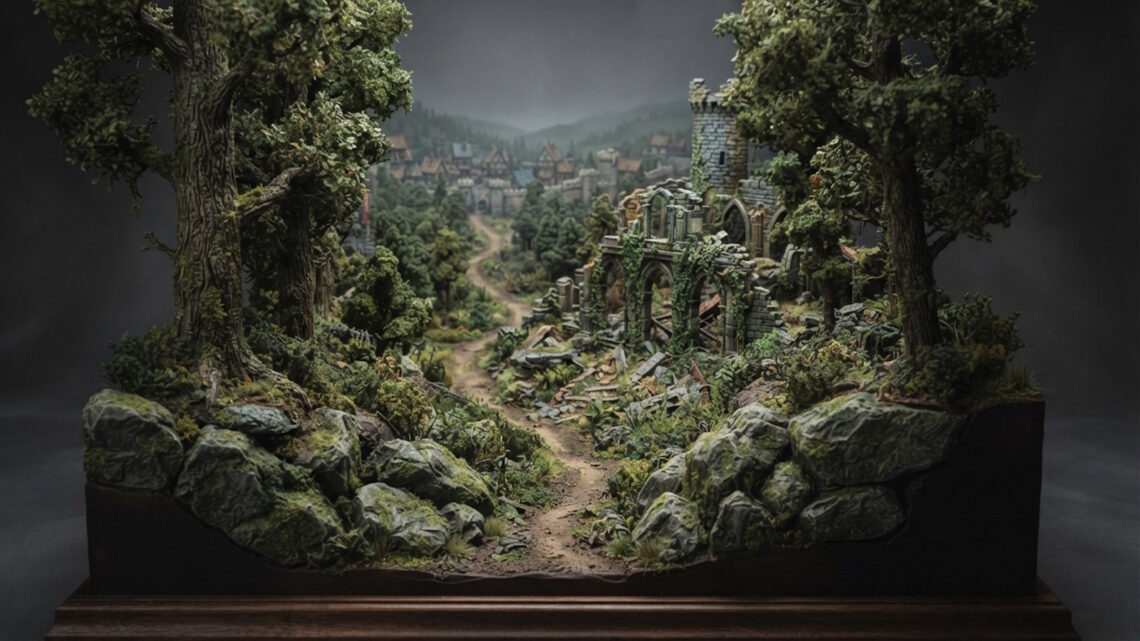
A ruined structure can be an excellent objective because it naturally attracts attention.
You could make a scenario where players need to control an old ruin, search it for an artefact or defend it against an approaching force.
The ruin can also provide cover, meaning the objective affects the battle in several ways at once.
Create Central Objectives
Objectives placed near the centre of the battlefield often encourage movement.
However, a completely exposed central objective can become difficult to reach.
Consider placing some terrain around it.
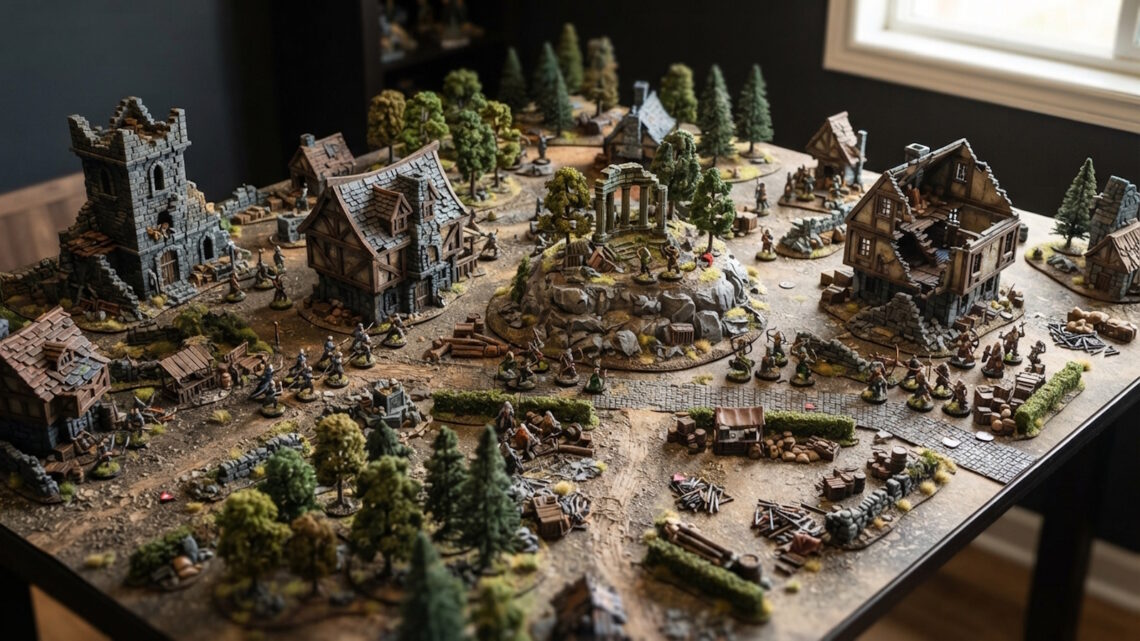
A central ruined building surrounded by a few pieces of scatter terrain can create an interesting contested area.
Players may have to decide how much of their force to commit.
Use Multiple Objectives
Several smaller objectives can be more interesting than one large objective.
For example, place three or four locations around the table.
Players then have to decide which ones to prioritise.
The terrain itself can make each location slightly different.
One objective might be in a ruin.
Another might be in woodland.
A third could be beside a group of crates.
This creates different tactical problems.
Make Objectives Visually Distinct
Players should be able to identify important locations quickly.
This does not mean every objective needs to be bright or oversized.
Instead, make them visually distinctive.
A chest in an otherwise empty room is easy to identify.
A group of barrels and crates can stand out from the surrounding terrain.
A large ruined structure can naturally become a focal point.
Avoid Hiding Objectives Too Well
An objective should be interesting, not impossible to find.
If it is completely hidden behind terrain, players may not know that it is there.
Use terrain to create tactical protection rather than making the objective invisible.
This is especially important in games where players need to understand the battlefield quickly.
Combine Objectives With Cover
One useful approach is to place objectives near terrain that provides some protection.
This creates a choice.
A player can move towards the objective and use the nearby terrain for cover, but may still have to expose themselves to opponents.
This is often more interesting than putting an objective in an entirely open area.
Create Different Objective Types
Terrain can represent different objectives depending on the scenario.
A chest could be something to retrieve.
A building could be something to capture.
A group of crates could need to be protected.
A ruin could need to be searched.
A tree or monument could represent a location that must be controlled.
This means the same terrain can support many different games.
Use Natural Terrain as Objectives
Objectives do not always have to involve buildings.
Natural terrain can also provide interesting locations.
A large tree could represent an ancient magical site.
A clearing could be the meeting point for two forces.
A prominent rock could mark a sacred location.
A fallen tree could hide an important object.
Natural objectives are particularly useful in woodland and wilderness scenarios.
Build a Story Around the Objective
Think about what the objective represents.
If players are fighting over a chest, why is it there?
If they are capturing a ruin, why does it matter?
If they are defending supplies, who needs them?
You do not need to write a detailed narrative for every game.
A simple idea can be enough to make the battlefield feel more meaningful.
Use Terrain to Create Risk
An objective can be valuable while also being dangerous.
For example, place an objective in a ruined building with several entrances.
Players can approach from different directions, but none are completely safe.
Alternatively, place an objective in an open clearing surrounded by woodland.
Players can see it easily but have little protection when approaching.
This creates tension without requiring complicated rules.
Make Objectives Moveable
Moveable terrain is particularly useful.
If a chest is an objective in one game, it can simply become scenery in another.
Likewise, crates and barrels can be used as objectives one week and ordinary scatter terrain the next.
This makes a relatively small collection much more versatile.
Don’t Overcrowd the Objective
The objective should remain visually identifiable.
If you surround a chest with twenty unrelated objects, it may become difficult to tell what actually matters.
Use a small group of supporting terrain instead.
A chest surrounded by two or three pieces of scatter terrain can look more convincing without becoming confusing.
Consider the Whole Battlefield
Objectives should work with the rest of the terrain.
If all objectives are placed in one heavily protected corner, players may have little reason to use the other parts of the table.
Spread important locations across different terrain zones.
This encourages movement and makes more of the battlefield relevant.
Use Terrain to Create Different Routes
Objectives can also encourage players to choose between routes.
An objective might be accessible through a forest, around a ruined building or across open ground.
Each route can offer different advantages and risks.
This is one of the strongest reasons to combine objectives with terrain rather than using isolated markers.
Keep It Simple
You do not need elaborate objective scenery.
A few barrels, crates, chests, ruins and natural pieces can go a long way.
The important thing is how they are used.
Good objective placement can turn ordinary terrain into part of the scenario.
Final Thoughts
Terrain-based objectives are a simple way to make tabletop games feel more connected to their environment.
Use chests for treasure, buildings for capture points, crates and barrels for supplies, and ruins or natural features for important locations.
Spread objectives across the battlefield, give players different routes and use nearby terrain to create interesting tactical choices.
The same terrain can then be reused in completely different scenarios, making it one of the most flexible parts of a tabletop collection.