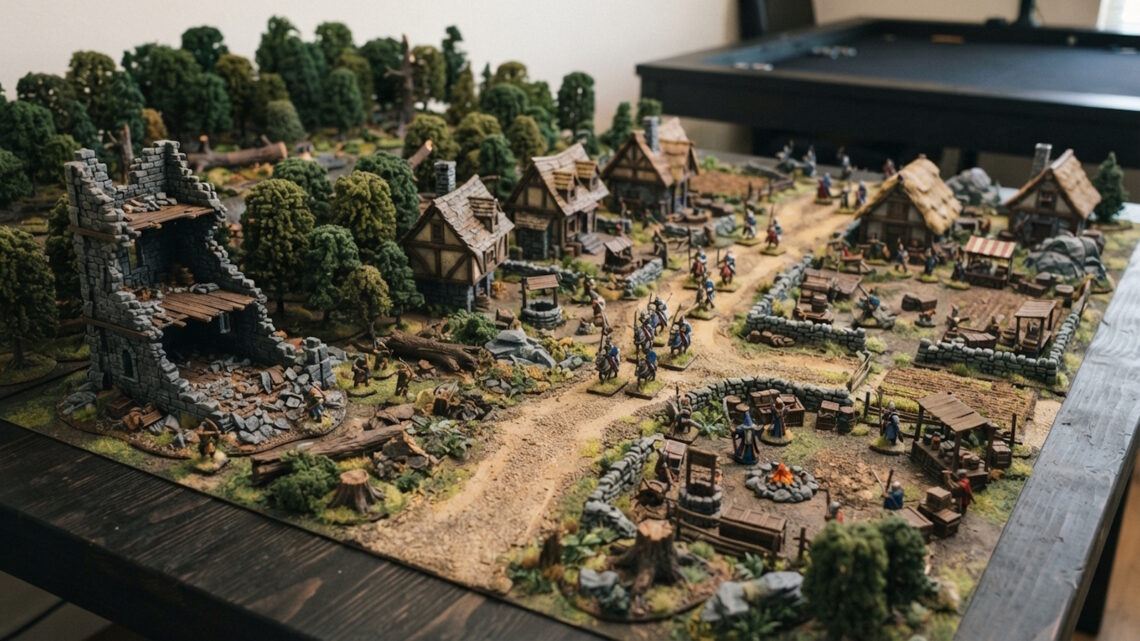
An abandoned ruin can make an excellent setting for a tabletop battle.
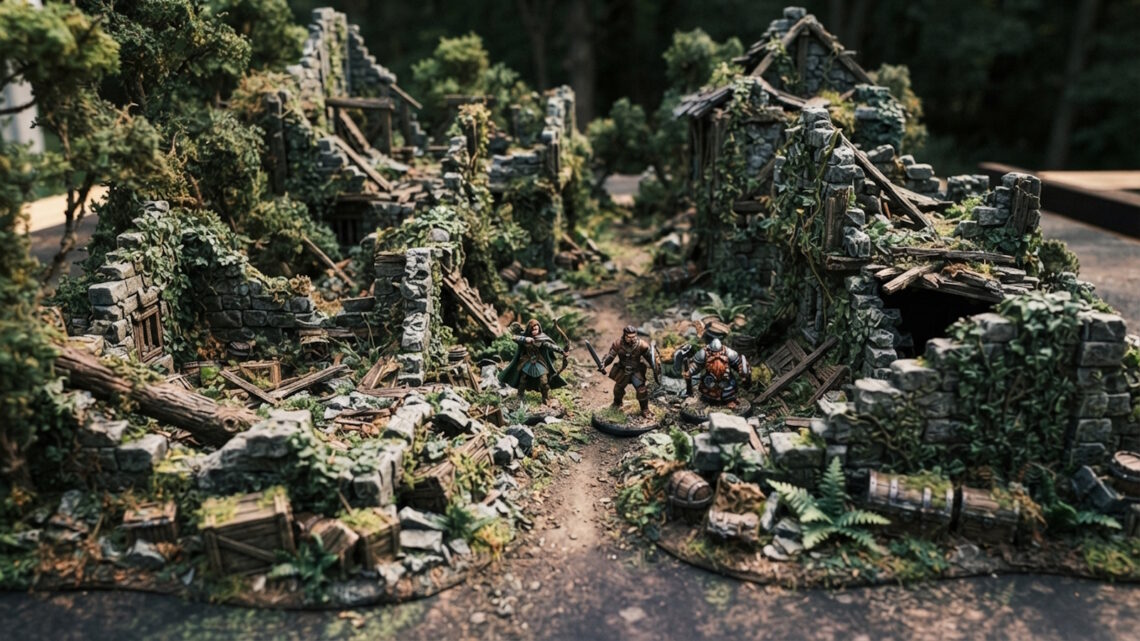
Broken walls, collapsed buildings, scattered rubble and overgrown vegetation can tell the story of a place that was once occupied but has since been forgotten.
Ruined terrain is also extremely useful during games because damaged structures can provide cover, block line of sight and create different routes across the battlefield.
The trick is creating a ruin that looks abandoned without making the table difficult to play.
Decide What Was Here Before
A ruin becomes more interesting when players can imagine what it used to be.
It might be:
- An abandoned village
- A ruined fortress
- An old temple
- A destroyed settlement
- A forgotten tomb complex
- A collapsed watchtower
- An ancient roadside structure
You do not need to explain its history in detail.
A few visual clues can be enough.
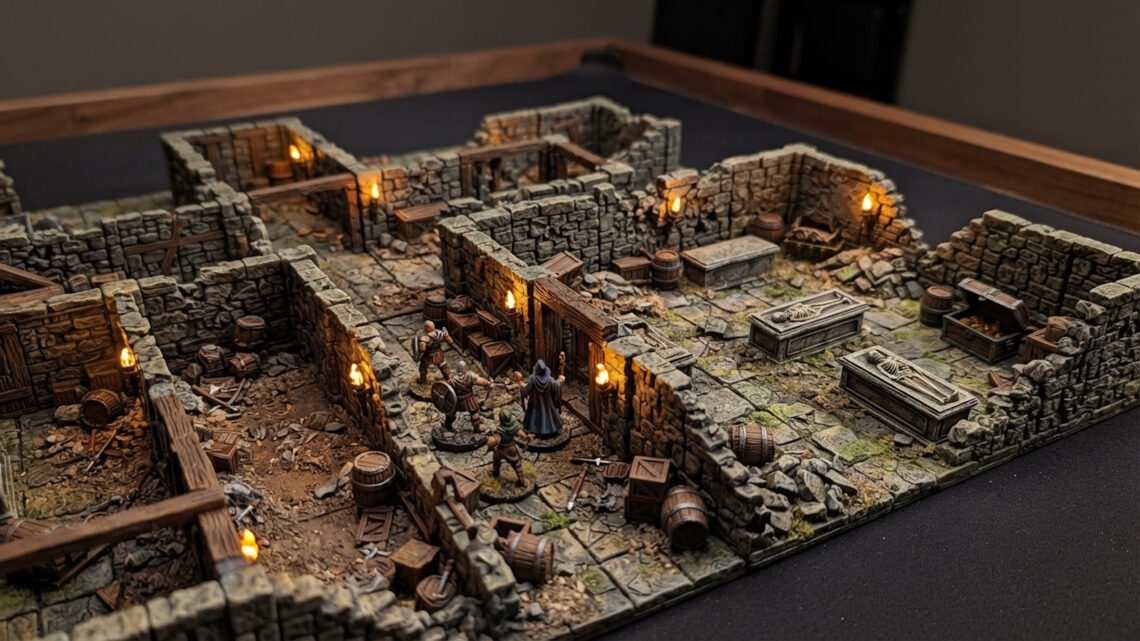
A broken wall and scattered storage objects might suggest a destroyed settlement, while tombs and stone coffins immediately create a very different atmosphere.
Start With the Major Ruins
Begin by placing your largest ruined structures.
These establish the main areas of the battlefield.
You could have one large ruined building surrounded by smaller walls, or several separate ruins spread across the table.
Try not to create a symmetrical arrangement.
A ruined battlefield should feel irregular.
Broken Walls Add Character
Walls are one of the most useful pieces of ruined terrain.
A partially collapsed wall can provide cover without completely blocking movement.
Broken sections can create gaps that miniatures can move through.
You can also combine different wall lengths to create structures that change from game to game.
This is particularly useful if your terrain collection is modular.
Add Rubble Around Damaged Areas
A broken building without debris can look strangely clean.
Small piles of rubble help connect the structure to the surrounding ground.
You do not need to cover the entire battlefield with debris.
Instead, concentrate it around areas that appear to have suffered damage.
A collapsed corner could have rubble at its base.
A broken doorway could have fragments nearby.
A damaged wall could have stones scattered along one side.
Use Different Heights
Ruins naturally create opportunities for varied heights.
Tall walls can provide strong visual elements.
Lower broken walls can provide partial cover.
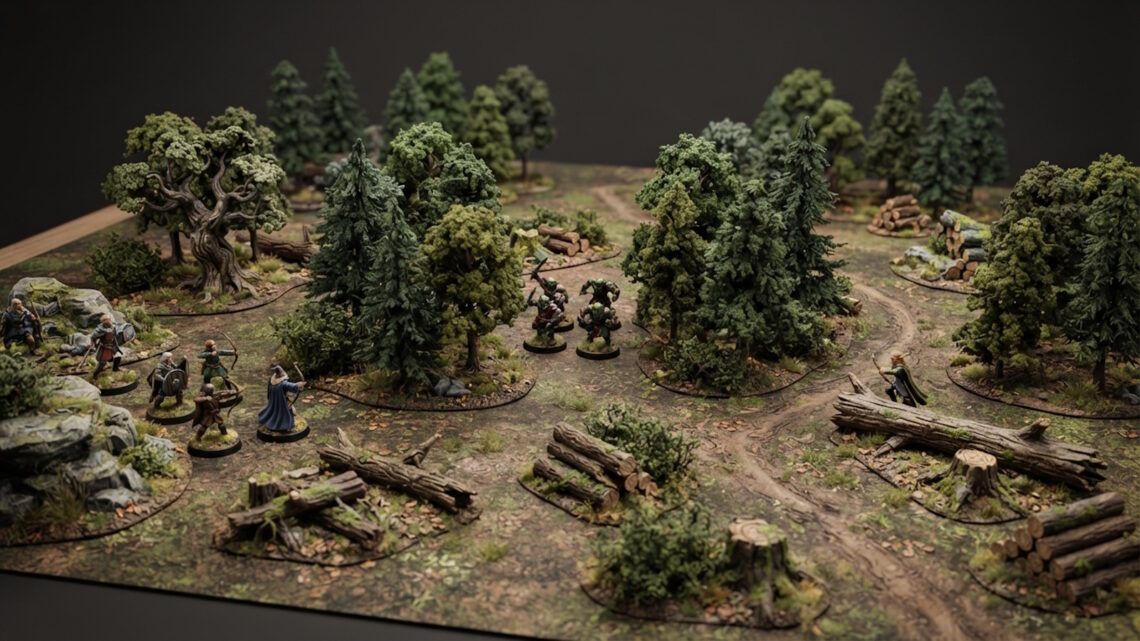
Trees and vegetation can provide additional vertical contrast.
Try to create several levels rather than having every terrain piece reach the same height.
This makes the battlefield more visually interesting and can also create more varied line-of-sight situations.
Let Nature Take Over
One of the easiest ways to communicate that a ruin has been abandoned for a long time is to add nature.
Trees growing around broken walls can suggest that the surrounding woodland has gradually reclaimed the area.
Tree stumps, fallen logs and other natural scatter terrain can reinforce this idea.
You can also use vegetation, flock or static grass around the base of ruined structures if it suits your terrain style.
The contrast between stone and nature can be particularly effective.
Add Small Signs of the Past
Scatter terrain can tell the story of what happened before the ruin was abandoned.
Depending on the setting, you could add:
- Barrels
- Crates
- Chests
- Sacks
- Broken furniture
- Tombs
- Coffins
- Fallen logs
- Storage objects
- Rubble
A single chest inside a ruined building immediately suggests that something of value might once have been stored there.
Several broken crates beside a wall can suggest that the building was once used for trade or supplies.
Use Tombs and Coffins Carefully
For ruined crypts, cemeteries and abandoned temples, tombs and stone coffins can become strong focal points.
They can also act as scenario objectives.
However, you do not need to place them everywhere.
A few carefully positioned burial pieces can communicate the setting more effectively than dozens of identical objects.
Create Different Types of Ruin
Not every ruin needs to look equally damaged.
One building might still have most of its walls.
Another could be little more than a foundation and scattered stones.
A third might have a single standing wall surrounded by rubble.
This creates a sense of progression.
Players can immediately see which areas remain relatively intact and which have suffered more severe destruction.
Use Ruins to Create Routes
Think about how the ruins affect movement.
A broken wall can force a unit to move around it.
A collapsed section might create a narrow passage.
An open doorway can provide an alternative route.
A large ruined building can create a central obstacle that divides the battlefield.
This turns the scenery into part of the game rather than simply decoration.
Avoid Blocking Everything
Ruins can easily become too dense.
If every wall completely blocks movement and line of sight, the battlefield may become frustrating.
Use a mixture of:
- Open areas
- Partial walls
- Broken corners
- Doorways
- Gaps
- Low rubble
- Larger structures
This gives players choices.
They can move around obstacles, pass through openings or use ruined walls for cover.
Create a Strong Focal Area
Consider creating one particularly memorable section.
It could be a large ruined building, an ancient tomb, a collapsed tower or a partially intact temple.
Give this area a little more detail than the rest of the table.
It can become the natural location for an objective or major encounter.
A strong focal point also gives the battlefield a sense of identity.
Mix Natural and Man-Made Terrain
The most convincing abandoned ruins often combine both.
Stone walls provide the remains of civilisation.
Trees and fallen logs show the return of nature.
Rocks and rubble blend the two environments together.
A few barrels or crates can suggest the area’s original purpose.
This mixture allows the same terrain collection to work across several different scenarios.
Use Colour to Suggest Age
Painting can dramatically change the appearance of ruined terrain.
Older stone can be given darker washes and varied highlights.
Wood can be painted in muted or weathered colours.
Vegetation can be introduced around the lower sections.
You do not need every stone to be a different colour.
Subtle variation is usually enough to prevent the ruin from looking completely uniform.
Build the Ruins Gradually
Start with a few key pieces.
For example, you could build a small ruined building surrounded by broken walls and rubble.
Then add natural terrain.
Later, introduce another structure or a different focal point.
This gradual approach allows you to see what the battlefield actually needs.
It also means the same pieces can be rearranged into completely different layouts.
Make the Collection Reusable
A ruined wall does not have to remain part of one specific ruin forever.
Move it to another area.
Combine it with trees for an overgrown settlement.
Place it beside a road for a roadside ruin.
Use it around tombs to create an abandoned cemetery.
Modular terrain provides far more variety than a collection of fixed layouts.
Final Thoughts
An abandoned ruins gaming table works because it combines visual storytelling with practical gameplay.
Start with major structures and broken walls, then add rubble, smaller scatter terrain and natural elements. Vary the amount of damage and leave enough open space for miniatures to move.
Trees, fallen logs and stumps can suggest that nature has reclaimed the area, while barrels, crates, chests and tombs can hint at what the location once was.
The result does not need to be perfectly detailed.
A few well-placed pieces can tell a surprisingly large story.