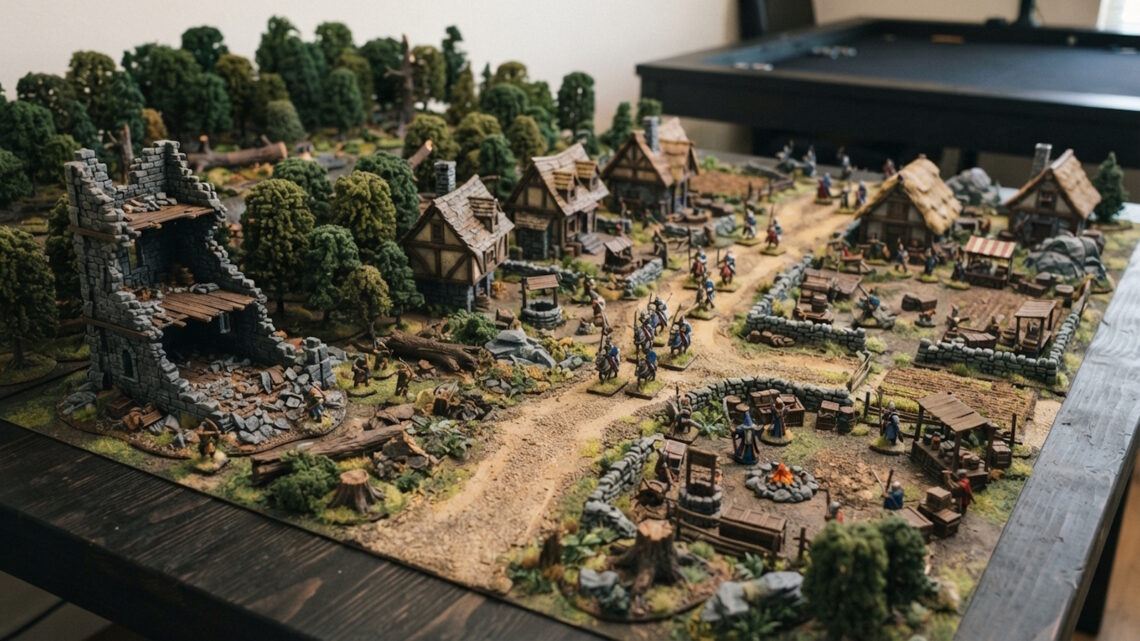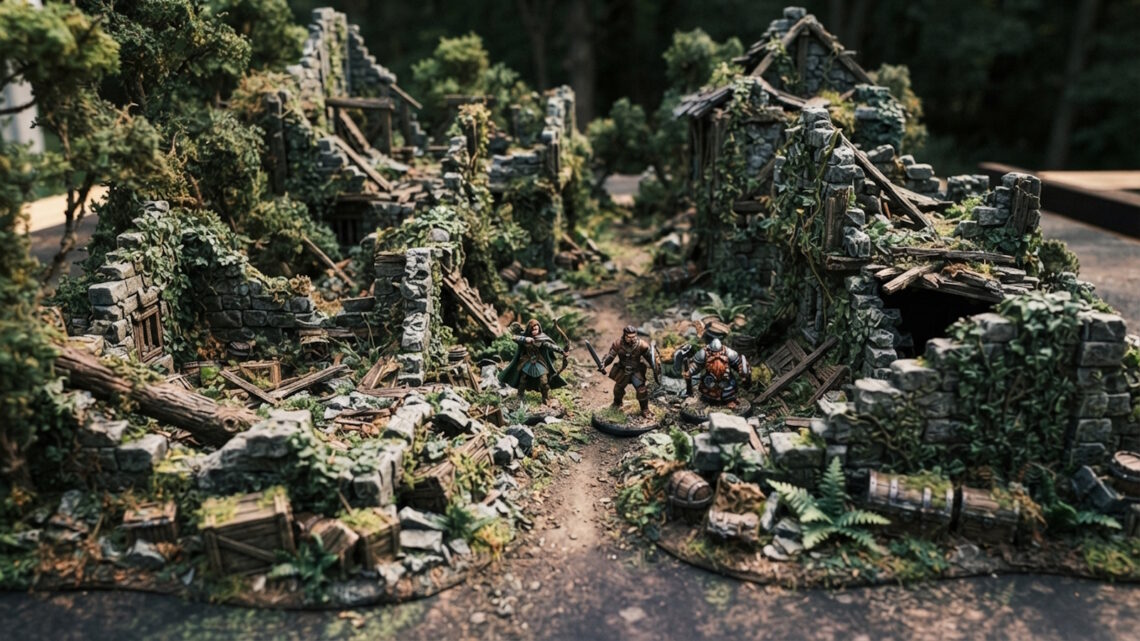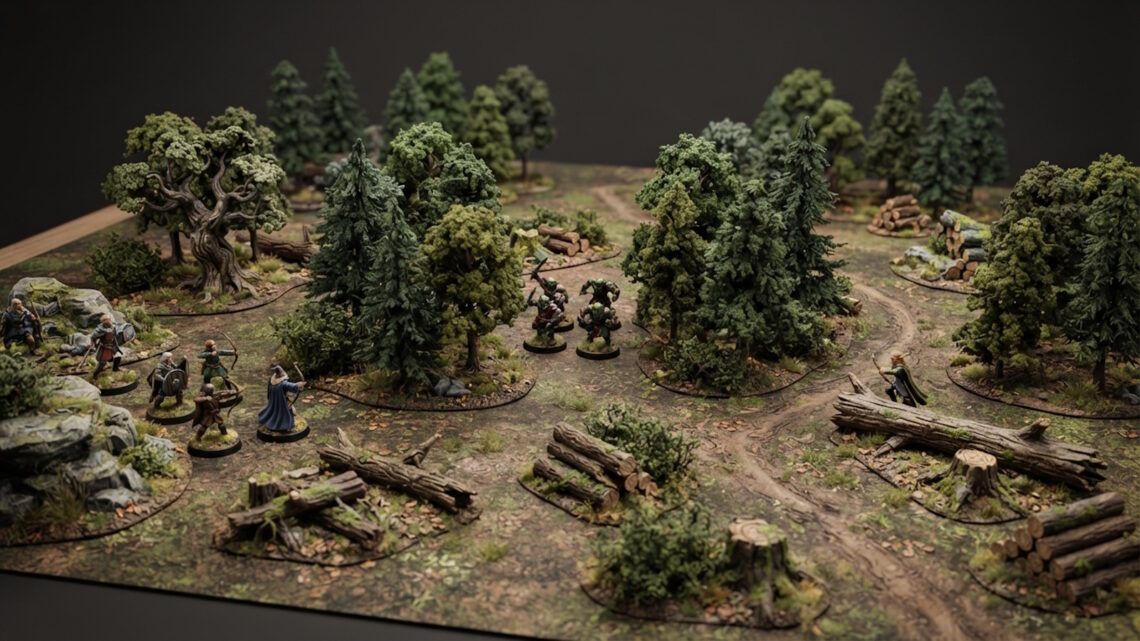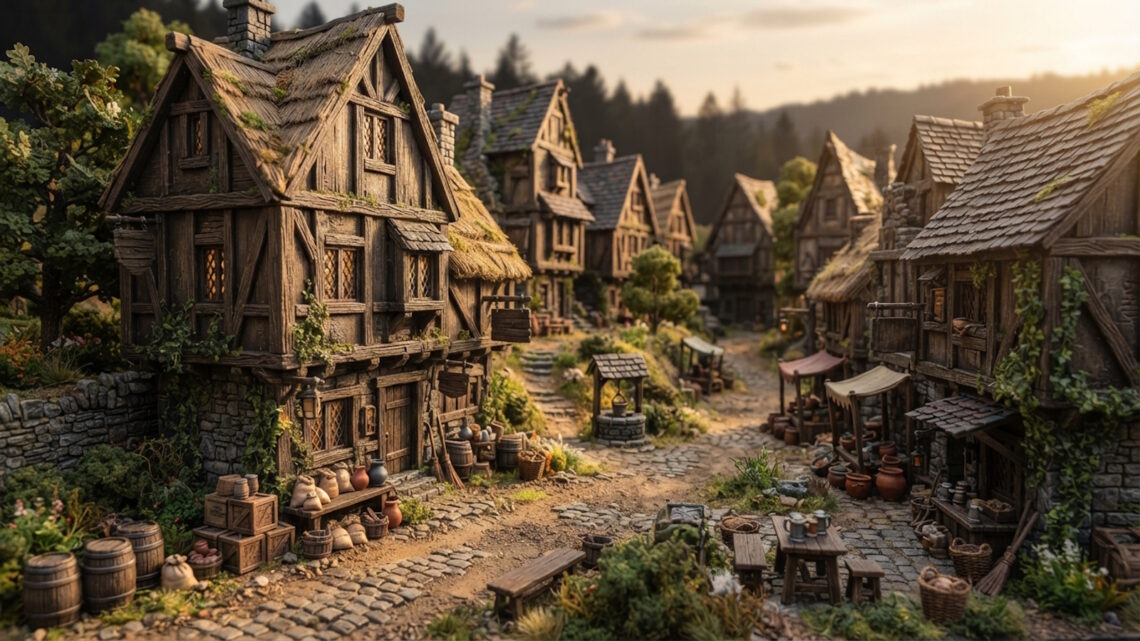
Buildings alone don’t necessarily make a miniature village feel like a real settlement.
The small details around those buildings are what often make the difference.
Barrels beside a doorway, crates near a workshop, sacks outside a store and vegetation growing along a path can all suggest that people actually use the space.
You don’t need dozens of figures to create this effect.
Start With the Buildings
Begin with the main structures.
Think about what each building might be used for.
A tavern might have barrels and tables nearby.
A workshop could have crates, tools or stored materials.
A home might have a bench, small garden or woodpile.
This gives each building its own identity.
Create Functional Spaces
Villages need areas where activities take place.
A road connects buildings.
A market area provides open space.
A storage area might contain crates and barrels.
A small green area could contain trees and benches.
Thinking about function helps prevent scenery from being placed randomly.
Add Everyday Objects
Small props are one of the easiest ways to create a lived-in atmosphere.
Useful examples include:
- barrels
- crates
- sacks
- chests
- baskets
- benches
- tables
- signs
- logs
- storage piles
You don’t need all of them.
Choose objects that make sense for each location.
Avoid Perfect Organisation
A lived-in village shouldn’t look completely tidy.
Objects can be slightly irregular.
Crates might be stacked unevenly.
A barrel might sit beside rather than directly against a building.
A few objects can be positioned along the edge of a path.
Small imperfections make the environment feel more natural.
Use Roads and Paths
The village street should connect the different areas.
Think about how people would move through the settlement.
A narrow path can lead to a side entrance.
A wider road can pass through the central area.
You can also create smaller paths that lead around buildings.
Add Vegetation
Vegetation helps soften the architecture.
Trees can sit beside homes.
Small plants can grow around walls.
Grass can appear along the edge of paths.
A few patches of vegetation can make a settlement feel much more connected to its environment.
Give Different Buildings Different Details
Avoid placing the same props around every building.
Instead, match the scenery to the building.
A tavern could have barrels.
A warehouse might have stacks of crates.
A cottage might have a bench and woodpile.
A farm building might have more natural scenery nearby.
This creates variety.
Add Signs of Wear
Perfectly clean scenery can make a village look newly constructed.
Subtle weathering can suggest regular use.
Dirt around paths, darker areas near entrances and worn edges can all help.
The amount of weathering can also indicate how old the settlement is.
Use Small Details Carefully
Small objects should support the larger composition.
Too many props can make the village difficult to read.
Leave enough open space that buildings and roads remain obvious.
A few carefully chosen pieces can often do more than dozens of random objects.
Create a Story
Think about what might be happening beyond the scene.
A delivery might have just arrived, leaving crates beside a building.
A merchant might store barrels outside a shop.
A damaged cart might suggest recent activity.
Even without figures, the scenery can imply that people have been there.
A lived-in miniature village is ultimately created through relationships.
Buildings establish the setting. Roads explain movement. Props suggest activities. Vegetation connects the settlement to its environment.
By combining these elements with a little irregularity and subtle weathering, you can create a miniature village that feels occupied and believable rather than simply assembled.