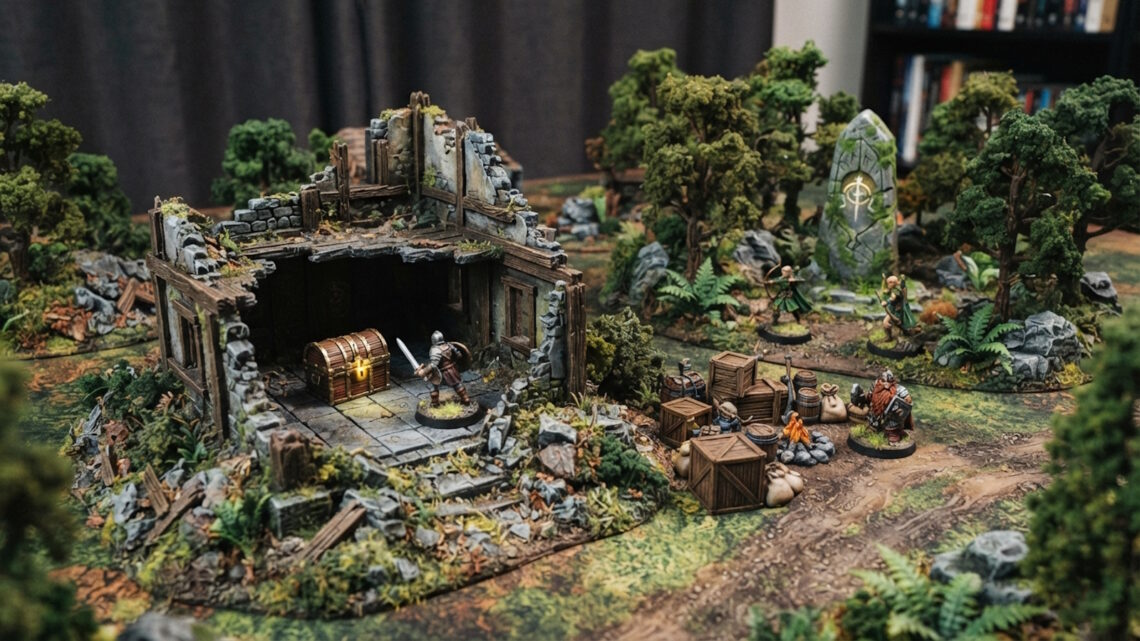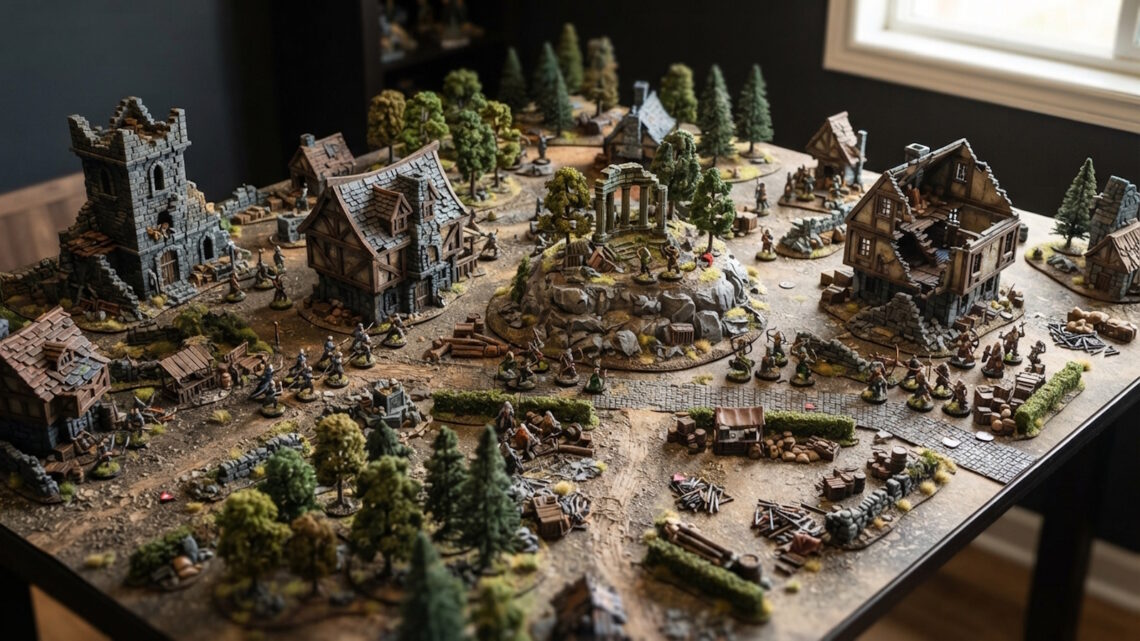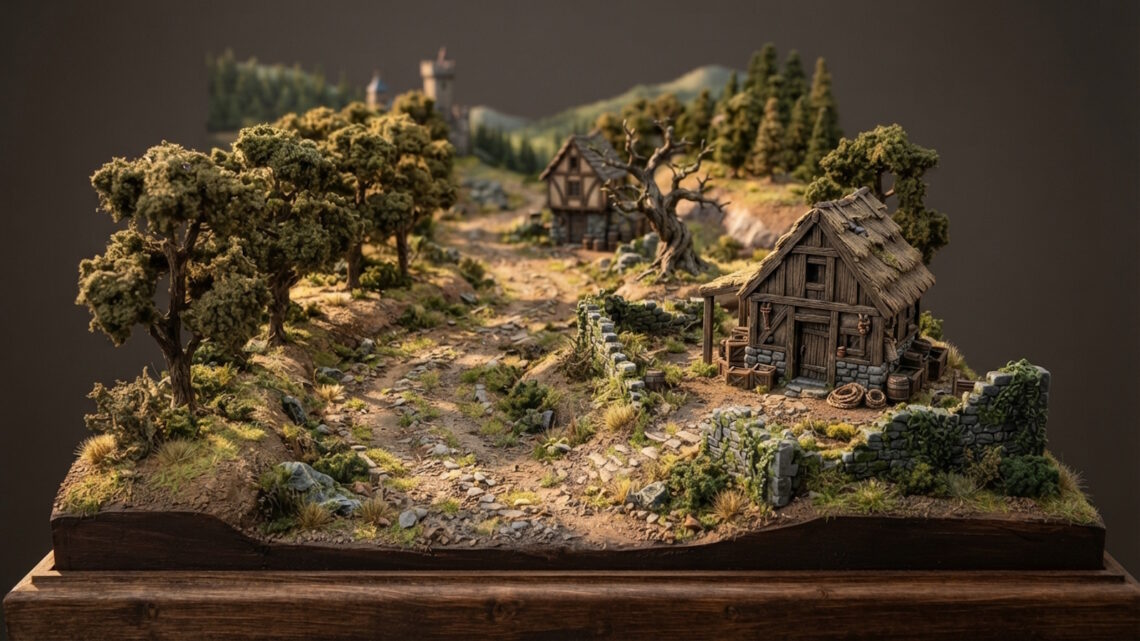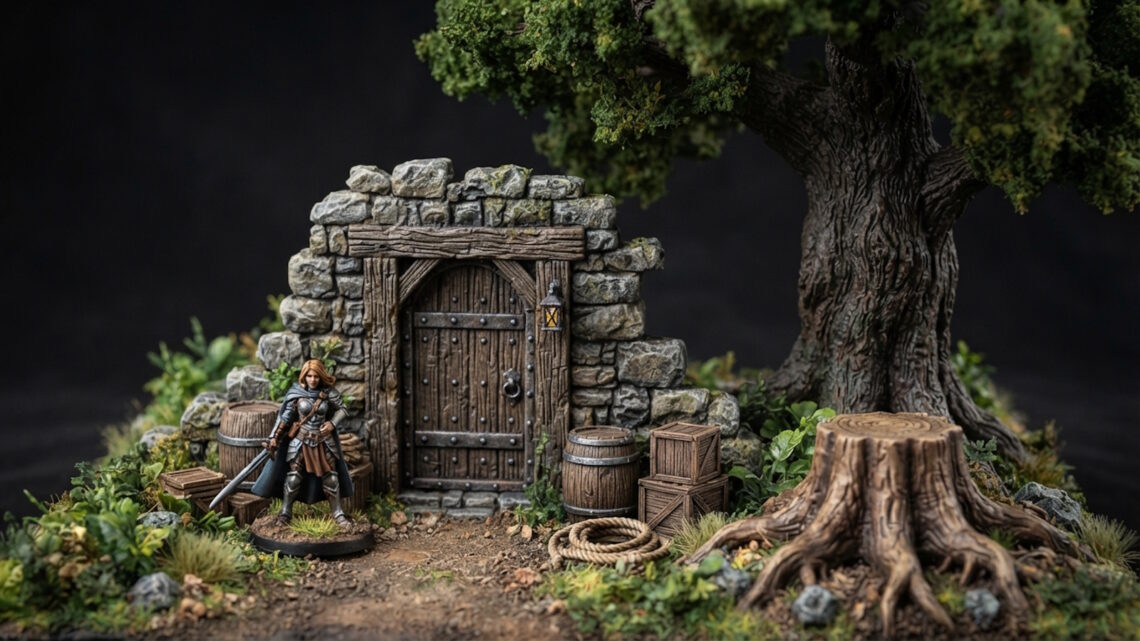
Scale is one of the most important elements of miniature scenery.
A scene can contain beautiful terrain and detailed models, but if the proportions don’t feel consistent, the environment can quickly look artificial.
Creating a convincing sense of scale means making objects appear as though they belong to the same world.
This matters whether you’re building a diorama, miniature display or tabletop environment.
Start With a Consistent Scale
The first step is deciding what scale you are working with.
Different miniature hobbies use different scales, so terrain, buildings, figures and props need to be compatible.
For many fantasy and tabletop environments, 28mm–32mm scale is common.
You don’t necessarily need every object to have identical proportions, but the main elements should feel compatible.
Use People as a Reference
Human figures are useful scale references.
A doorway, barrel, chair or chest can be compared against the approximate size of a person.
This gives viewers an immediate understanding of how large the scenery is supposed to be.
Even if your final display contains no figures, temporarily using one during construction can help.
Think About Function
Objects should also make sense based on what they are used for.
A doorway needs to be large enough for its occupants.
A table should be an appropriate height.
A crate should be manageable for the people who would carry it.
A barrel should have believable proportions relative to the surrounding buildings.
Thinking about function often reveals scale problems.
Don’t Make Everything the Same Size
Real environments contain variation.
Not every tree is the same height.
Buildings can differ.
Rocks and props naturally vary.
Variation can actually make a scene feel more realistic as long as the differences remain believable.
Use Perspective
Perspective can change how scale is perceived.
Objects closer to the viewer can appear larger while distant objects appear smaller.
You can use this naturally in a diorama by placing larger scenery in the foreground and smaller scenery further back.
This is especially useful for trees and background buildings.
Be Careful With Trees
Trees are particularly important because they can dominate a miniature landscape.
A mixture of sizes usually looks better than identical trees.
Large trees can establish the main canopy while smaller trees fill gaps.
Dead trees, stumps and fallen logs can introduce additional scale variation.
Use Familiar Objects
Some objects are immediately recognisable.
Barrels, crates, benches, doors and stairs can all help communicate scale because viewers already understand their approximate real-world proportions.
Including familiar objects can therefore make an unfamiliar fantasy environment easier to understand.
Keep Architecture Consistent
Buildings need to relate to one another.
A small cottage beside an enormous doorway can look strange unless there is a deliberate reason for the difference.
Doors, windows, stairs and furniture should generally support the same overall scale.
Fantasy settings allow more freedom, but consistency still matters.
Use Terrain to Reinforce Scale
Terrain can also communicate size.
Large rocks can make a miniature figure appear small.
A narrow path between tall trees can make a woodland feel imposing.
A small building surrounded by large trees can create the impression of a remote settlement.
These relationships are useful tools for composition.
Don’t Chase Mathematical Perfection
Miniature scenery doesn’t always need to follow exact real-world measurements.
Stylised terrain often exaggerates certain features for visual reasons.
Doors may be slightly larger.
Trees may be more substantial.
Stonework may be exaggerated so that details remain visible.
What matters most is consistency across the scene.
Check the Scene From Different Angles
A scale problem may not be obvious from one viewpoint.
Look at the scene from the front, side and above.
If the major elements still feel related from different angles, the overall scale is probably working.
Creating convincing scale is less about measuring every object and more about making the relationships between objects believable.
Use a consistent miniature scale, check scenery against familiar objects and figures, vary sizes naturally and pay attention to perspective.
When those relationships work together, even a highly fantastical miniature world can feel surprisingly believable.